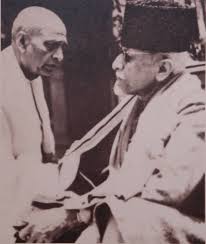
Work in Progress : 9
GEM OF A NATION
A Political biography of Dr Rajendra Prasad
By Dr BSM Murty
This extract
(Part VII, Ch. 3) from a seven-part book relates to President Rajendra Prasad’s
visit to the Soviet Union in June-July, 1960. During the firt eight years of
his Presidency (till 1958) the External
Affairs Ministry under Nehru had always been reluctant towards Dr Prasad’s
foreign visits, even though there were a number of standing invitations
extended to him by visiting Heads of State from several countries, including UK
and USA. It was only during 1958-’59 that his foreign tours were finally
approved. His first ever foreign tour was to Nepal followed quickly by a long
tour of Japan and the countries in the South East Asia – Malayasia, Indonesia, Cambodia,
Vietnam, Laos and Ceylon. This in turn was followed a year later by his visit
to the Soviet Union. Here is the story of that visit to the Soviet Union.

Visit
to the Soviet Union
A year later, in June 1960, Dr
Prasad went on a fortnight’s visit to the Soviet Union. If Buddhism and common
cultural heritage was the central theme of his visit to the South East Asian
nations, this time it was professedly political – non-alignment and disarmament.
After more than a decade of independence India had come to have, under the
dynamic leadership of Nehru, an unenviable position as a champion of political
neutrality and world peace. With the swift ascendancy of communism in the Soviet Union and China a
formidable power bloc had emerged in Euresia that was in direct confrontation
with the erstwhile imperialist nations of the West. At the same time, in the
post-World War scenario, an all-round rapid decline of colonialism had brought
about a sudden upsurge of freedom and progress in the Afro-Asian countries that
were ready to impinge upon the ‘Cold War’ equilibrium between the two mighty
power blocks of East and West. In short, the visit of the Indian President to
the Soviet Union had come at a time when the international political situation
was under great turbulence both at home and abroad. And though Dr Prasad in his
writings and speeches always evinced genuine concern with all issues of foreign
affairs with both national and international ramifications, he scrupulously
kept himself aloof from any direct involvement in the foreign policy area.
Dr Prasad was now seventy-six
with only two years left for his final leave-taking after a twelve-year long
tenure as President. Also, this journey to Soviet Russia was to be the last of
his foreign sojourns. Exchanges of reciprocal visits between the two countries
had taken place in the recent past by the top Russian leaders, Khrushchev and
Bulganin and Nehru and Dr Radhakrishnan, and there was a distinct tilt in the
Indian foreign policy towards the Soviet Union foreshadowing an uneasy equation
with the USA. Though an apparent façade of diplomatic equilibrium was being
maintained through more recent visits of the US President Eisenhower and the Soviet
President Voroshilov in quick succession. However, being a pacifist supporter
of world peace through complete disarmament, Dr Prasad’s sympathies were
clearly tilted against the Western powers, the perpetrators of the recent
nuclear holocaust in Japan and adherents of a manifest policy of aggressive
armament. His forthcoming visit to the Soviet republics was fairly to augment
his interest in the pro-people communist dispensation with its palpable faith
in a peaceful world order and its amazing achievements in building a
prosperous, egalitarian social order in rapid strides. As R.L.Handa, Dr
Prasad’s Press Secretary who accompanied him on these travels, writes in his
memoir: “The President was keen to
acquire first-hand knowledge about [the Soviet Union’s] economic development
and the standard of living of the people there. The bewildering variety of
races constituting its population and scores of languages spoken by them also
attracted Rajendra Prasad…[He] was particularly keen to know [about] the
general tenor of of people’s life, their views on religion and the nature of
their response to the Communist way of life.”
Only a few months before Dr
Prasad’s sojourn to the Soviet Union began, both President Voroshilov and
Premier Khrushchev had come to India on
a goodwill mission as India was already under various kinds of aids from the
Soviet government in its ongoing agricultural and industrial enterprises.
President Voroshilov’s visit happened in
January, 1960, which included his formal presence as a special guest at the
Republic Day function. President Voroshilov’s visit had been followed a
fortnight later by the Premier Khruschev’s visit, and both these high-profile
visits were in a way part of a diplomatically designed cultivation of
increasing goodwill preparatory to the ensuing visit of the Indian President to
the Soviet republics barely four months later. During his two-week stay in
India, President Voroshilov seems to have struck a very amiable companionship
with Dr Prasad. “A nice old man”, recalls Handa, “ [President Voroshilov] felt quite homely
during his stay at Rashtrapati Bhavan…[he] met Rajendra Prasad quite a few
times, twice during his morning walks in the Mughal Gardens.” In his diary, Dr
Prasad himself reminisces about those morning encounters.
He
said more than once that the [Mughal] Garden was a paradise…He told me that his
own garden was not like this but he used
it for regular walks. There are marks to indicate distance and his ADC makes
note of the distance covered everyday. It came to about 240 or 250 kilometres
in a month. He used to do more than double of what he does now….[He] insisted
that I should walk everyday starting with a short distance and increasing it
gradually…[He even] suggested that yogic exercises would cure my asthma and
that I could begin it even at this age as I was not older than him… I find Mr.
Voroshilov quite frank and friendly and taking interest in everything that he
sees. He started life as a worker and rose to be a Marshal of the army and has
been the President for the last 5 or 6 years.”
During his stay at the Rashtrapati Bhawan, writes Handa, President Voroshilov, “talked
freely and, without touching on politics, would project an unbiased picture of
the varying stages of development obtaining in western and Asian Republics of
the Soviet union. “ Dr Prasad was quite impressed by his talks, “particularly
[his] views on religion, which he
thought were marked by a deep understanding”. This short stint of
familiarity with Voroshilov, gave Dr Prasad a soft spot for the old man, three
years his elder, and when four months later, he visited Soviet Union, he
carried two boxfuls of gifts for him and his family. Voroshilov had meanwhile
been replaced by Breznev as Preident of the Soviet Union and there occured a
small episode of discomfiture for Dr Prasad as during his visits to Moscow and
Leningrad he could neither meet Voroshilov nor present him the boxes of gifts
as the latter’s whereabouts could not
even be ascertained by the concerned
Russian Protocol officer.
By the time Dr Prasad’s visit to the Soviet Union
began the political configuration of leadership there had undergone a change.
Khrushchev was now the man at the helm with Breznev as President of the Union.
Voroshilov, an old associate of Stalin, had been quietly pushed into oblivion
under Khrushchev’s new power set-up. Though aware of this change, Dr Prasad, in
a typical Indian gesture of goodwill, still desired to renew his contact with
the genial Voroshilov which sadly resulted in some embarrassment. Handa
recounts that small glitchy story.
[Before
embarking on his journey] Prasad took personal interest in procuring suitable
presents for [Voroshilov], his wife and children to be handed over to them
during his impending visit to their country. Besides, he also looked forward
with eagerness to meeting the old man in Moscow and chatting with him…On the
second day of his arrival in Moscow…he was reminded of Voroshilov whom he
wanted to see, if possible, or at least to pass on to him the presents he had
brought for him and his family. So, the President asked his Military Secretary
to find out from the Russian Chief of Protocol about Voroshilov’s whereabouts.
When asked about Voroshilov, the Russian officer said he would try to find out
and inform the General on the following day. The President felt happy when he
was told about it. On the following day before leaving for a formal lunch, the
same Russian officer spoke to the Military Secretary, on his own, giving the
impression that Voroshilov was out of town, possibly in Leningrad. The
President who was scheduled to visit Leningrad
after two days felt quite happy at the prospect of meeting Voroshilov
there. The two boxes containing the presents meant for Voroshilov were therefore
taken to Leningrad as the President’s party moved there….[In Leningrad] the
President reminded his Military Secretary of the presents. Again the General
asked the same Russian officer…This time, his reply was ready. He made no
pretence of trying to trace Voroshilov’s
whereabouts, and said instead that being in indifferent health the Marshal preferred
to spend most of his time in the countryside. To the best of his impression, he
added, he might be staying at some spa. If Sochi be his choice, it would be
lucky, the officer said, for within a few days the President was going to visit
that beautiful health resort on the Black Sea…[After knowing all this] the
President gave up the idea of either seeing Voroshilov or sending the presents
to him. “I am wiser now. Give up the idea. Don’t ask about the Marshal any
more,” he told the General.

Arrival
in Moscow
“I flew from Delhi to Tashkent and thence to Moscow”, writes Dr
Prasad in a long note on his “Impressions of the Soviet Union”. In a brief stopover at Tashkent, he expressed
his happiness to have arrived with all the goodwill from India in the land of
the Soviet people. Though it was his first visit to their country,he said, he
had heard so much about the great achievements of the Soviet people during the
past few decades, and particularly
during the last seven years, that
he already felt so familiar and at home in their wonderful country.
When his presidential plane, escorted by Soviet jet
fighters, landed at the sprawling Vnukovo airport near Moscow, large welcome posters with images of
President Breznev, Premier Khrushev and himself greeted the Indian President’s
entourage that consisted of Morarji Desai, the Finance Minister, Jagjivan Ram, Railways
Minister and close confidante of Dr Prasad, and other officials of the Indian
government. Replying to President Breznev’s welcome speech, Dr Prasad expressed
his gratitude for the ‘kind and gracious welcome’ extended to him and ‘the
generous assistance’ India had been receiving from the Soviet government in its zealous efforts in the fields of agriculture and ‘rapid industrialisation’. He
also referred to the ‘question of world peace’ and the dedicated efforts the
Soviet government was making towards
that goal, a theme that was to be reiterated in all his speeches during his
fortnight-long stay there.
 Dr Prasad’s itinerary included visits to some of the
major cities of the Soviet Union like Leningrad, Kiev, Sochi, Stalinabad,
Samarkand and Tashkent. “Moscow, Leningrad and Kiev”, he writes in his long
note of ‘Impressions’, “are the three biggest cities in the USSR, and
Stalinabad is the capital of the Republic of Tajikistan and Tashkent the
capital of the Republic of Uzbekistan. We covered in this way, apart from the
Federation of Rusian Soviet Republics, the Republics of Ukraine, Tajikistan and
Uzbekistan.” The first three days of the
itinerary were spent in Moscow with a series of formal meetings with President
Breznev and visits to the Lenin and the Stalin mausoleums and other historical
monuments, including Lenin’s study and flat in the Kremlin where the guide told
him, among other things, about the Indian delegation that had come as early as
November, 1918, to meet Lenin with a message of
goodwill and friendship. On the evening of 21 June, Dr Prasad attended
with President Breznev, Mikoyan, Furtseva and other senior Russian leaders a
performance of Chaikovsky’s ballet ‘Swan Lake’ at the famous Bolshoi Theatre.
The audience in the theatre greeted the two Presidents with a ‘stormy
applause’
Dr Prasad’s itinerary included visits to some of the
major cities of the Soviet Union like Leningrad, Kiev, Sochi, Stalinabad,
Samarkand and Tashkent. “Moscow, Leningrad and Kiev”, he writes in his long
note of ‘Impressions’, “are the three biggest cities in the USSR, and
Stalinabad is the capital of the Republic of Tajikistan and Tashkent the
capital of the Republic of Uzbekistan. We covered in this way, apart from the
Federation of Rusian Soviet Republics, the Republics of Ukraine, Tajikistan and
Uzbekistan.” The first three days of the
itinerary were spent in Moscow with a series of formal meetings with President
Breznev and visits to the Lenin and the Stalin mausoleums and other historical
monuments, including Lenin’s study and flat in the Kremlin where the guide told
him, among other things, about the Indian delegation that had come as early as
November, 1918, to meet Lenin with a message of
goodwill and friendship. On the evening of 21 June, Dr Prasad attended
with President Breznev, Mikoyan, Furtseva and other senior Russian leaders a
performance of Chaikovsky’s ballet ‘Swan Lake’ at the famous Bolshoi Theatre.
The audience in the theatre greeted the two Presidents with a ‘stormy
applause’
.
Among the next day’s important engagements was the
reception given in honour of Dr Prasad by the diplomatic representatives of the
Bandung signatory countries in which President Breznev was also present along
with the other senior Soviet leaders. Addressing the distinguished gathering,
Dr Prasad said that Bandung represented ‘the end of one epoch in the history of
Asia and Africa and the beginning of another’, heralding ‘the march to complete
liberation of Asia and Africa from colonial rule’. But he added: “Independence
is no longer an issue either in Africa or in Asia. The question is one of
consolidating freedom by giving it a broad economic base. In this there is
considerable room for mutual cooperation and assistance amongst the Asian-African
countries themselves. Indeed one of the main objects of the Bandung Conference
was to discuss ways and means by which the Asian and African people could
achieve fuller economic, cultural and political cooperation”. At the end of his
speech he also expressed his ‘appreciation’ for the ‘generous assistance that
we in Asia and Africa have received from the Soviet Union’.
President Breznev in his concluding speech also emphasized the ‘growing unity’ among the Afro-Asian nations and said that ‘the solidarity of the Asian and African countries and their friendship with the Soviet Union and other socialist States have become one of the most important factors of the present international situation’.
The same evening Dr Prasad and his presidential
contingent left by train for Leningrad. In his diary Dr Prasad describes that
overnight train journey.
 The
train which was their special show piece was a pretty long one with a large
number of carriages, each with some compartments. They were all well furnished
and looked quite clean. I do not know the speed, which can be calculated on the
basis of the information I got. The distance of about 450 miles between Moscow
and Leningrad was covered by our train in something like 10 to 11 hours, There
was no appriable jolting and shaking and in this respect it seemed to be even
better than our saloons in India….
The
train which was their special show piece was a pretty long one with a large
number of carriages, each with some compartments. They were all well furnished
and looked quite clean. I do not know the speed, which can be calculated on the
basis of the information I got. The distance of about 450 miles between Moscow
and Leningrad was covered by our train in something like 10 to 11 hours, There
was no appriable jolting and shaking and in this respect it seemed to be even
better than our saloons in India….
The President’s special train reached Leningrad’s
Moscow station on the morning of 23 June where Dr Prasad received a tumultuous
welcome by Soviet officials and the common citizens. Later in the afternoon Dr
Prasad visited Smolny where he saw the room in which Lenin lived during the
stormy days of the October Revolution. He also visited the assembly hall in the
Smolny Institute ‘where Lenin, addressing the Second All-Russia Congress of the
Soviets, proclaimed Soviet power and the policy of peace and friendship among
nations’. [CSD21/403] After Smolny the presidential party went sightseeing to
the Russian Museum and the Pushkin monument and from there to see the Baltic
Shipyards production unit. “We visited the ship building yard”, writes Dr
Prasad in his diary, “ and saw the constructing of a 4,000 ton tanker named
Budapest….[The] workers told me enthusiastically that not only the tanker with
all its parts were built by them but that many of the heavy machines which had
been used in building such ships had been forged and constructed there.”
[CSD21/32] It was in Dr Prasad’s presence, amidst music and cheers of the
workers, that the massive tanker Budapest slowly slid down its launch
pad into the mouth of the Neva river. Later in the evening, amidst great ovation,
Dr Prasad witnessed a ballet named ‘The Fountain of Bakhchisarai by Asafyev at
the Kirov Opera and Ballet Theatre
.
On the next morning, Dr Prasad visited the Institute
of Oriental Studies, a part of the USSR Academy of Sciences, where high-level
research was carried on in a number of Eastern languages: Sanskrit, Hindi,
Punjabi, Tamil, Telugu and Marathi. A senior scientist at the Institute, Prof.
Kalyanov, read part of his speech in Sanskrit as a tribute to Dr Prasad’s own
proficiency in the classical Indian language. Translations of Sanskrit classics
like Kautilya’s Arthashastra and Mahabharata, along with an
encyclopaedia of Indian culture had already been published by the Institute
which specialized in the training of Indologists and other orientalists in the
Soviet Union. The President was also shown an exposition of ancient manuscripts on different branches of
India’s ancient and medieval science.
Gifts of a Sanskrit dictionary and some books by Soviet Indologists were made
to the President who also reciprocated by presenting to the Institute an
eight-volume biography of Mahatma Gandhi. Later Dr Prasad visited the large,
sprawling Hermitage Museum comprising of six historic buildings including the
old Winter palace of the Russian Tsars. It is said to be the oldest museum in
the world with the largest collection of paintings and various items of
historical value. In his diary he writes:
Today
we visited the old palace of Peter the Great which was largely destroyed during
the war but has since been practically rebuilt. Its great beauty consists in
the large number of fountains which I was told did not sprout water under
artificial pressure but under force of gravity as the water came from a place
some 30 kilometres away….[There were a] number of statues and figures which were all gilt and
looked like shining gold and through different parts of which jets of water
came out…[with] coloured light passing through fountains
…
The
big museum and collection of works of art of things of antiquity at the
Hermitage are superb. There are some 300 rooms of which nearly 30 contain
paintings of masters, a few of which we could see. We saw however a large
collection of gold ornaments and other things which were said to be of 4th
or 5th century B.C. The collection of paintings and statues of
masters is wonderful. It is a pity we had so little time.

The President’s next stop was the capital of
Ukraine, Kiev, built on both sides of the river Dnieper. The flight from
Leningrad took two hours to Kiev where he was warmly welocomed at the airport
by the President of the Ukrainian Republic. His stay in Kiev was to be brief,
he said, but he would be happy ‘to see its sights and meet with its residents’.
As the presidential convoy drove to the President’s residence, tens of thousands
of people lined the road on both sides swaying flags and streamers and chanting
welcome. “In the afternoon,” Dr Prasad notes in his diary, “we saw the
exhibition of what they call achievements. In every big city they have a
permanent exhibition like this. They are beautiful permamnent pavilions….At
night we saw an opera in which [the] scene was laid in a forest and the story
was of nymphs…The scenry that was depicted on the screen was marvelous….We had seen the ballet at
Moscow and Leningrad but the scenery here was superb.”
Next day, on 26 June, Dr Prasad and his party spent
several hours at a collective farm in a village near Kiev. He notes in his
diary:
In
the morning we visited the Drujba (‘friendship’) Kolkhoj
(‘collective farm’). It is about 50 kilometres from Kiev with a population of
4,200 comprising 1,020 families and has 567 hectares of land…They grow beet,
maize, wheat, barley and peas in the 750 hectares…. Seeds are supplied. Each
family with two workers working 200 days of 8 hours each in a year…and each
gets as his share from the collective farm according to his work 13 to 14
thousand roubles for the year at its end,….Each family has a house which it
acquires after paying 7, 8 or 10 annul instalments fixed by the committee
according to his capacity to pay. It also gets [some] land attached to the
house on which it can grow fruits, vegetables and anything else it likes….It
was a most interesting and informative trip. I took full notes….In the
afternoon we went out on [a] boat trip on the Dneiper….We saw thousands of
people on the left bank having river and sun bath. They were all dressed in
very scanty clothes,”
 From Kiev the President’s
contingent flew to Sochi, the world-famous largest health resort city in
Russia; a large sprawling city along the northern shores of the Black Sea which
is a part of the Caucasian Riviera. The beautiful city is located on the slopes
of the western Caucasus mountain gradually descending to the pebble and sand
beaches of the Black Sea. It is famous for its hot spring spas and health sanatoria. Dr Prasad visited some of
these palatial snatoria and met the holiday-makers. Next morning he was taken
in a motor launch along the sea coast and in the afternoon he visited the Riviera
park where he planted an evergreen magnolia tree. Interestingly, only recently
the erstwhile President Voroshilov had also planted some trees in the same
glade. Dr Prasad recalls that Sochi visit in his diary:
From Kiev the President’s
contingent flew to Sochi, the world-famous largest health resort city in
Russia; a large sprawling city along the northern shores of the Black Sea which
is a part of the Caucasian Riviera. The beautiful city is located on the slopes
of the western Caucasus mountain gradually descending to the pebble and sand
beaches of the Black Sea. It is famous for its hot spring spas and health sanatoria. Dr Prasad visited some of
these palatial snatoria and met the holiday-makers. Next morning he was taken
in a motor launch along the sea coast and in the afternoon he visited the Riviera
park where he planted an evergreen magnolia tree. Interestingly, only recently
the erstwhile President Voroshilov had also planted some trees in the same
glade. Dr Prasad recalls that Sochi visit in his diary:
It
is a health resort and has some 49 sanatoria…and has always about 15 to 20 thousanf
visitors in the sanatoria, Very few individuals from the country come here on
their own. But foreigners do in large numbers [and] the various institutions
remain full with men and women of different trades and factories. The charges
which they have to pay are very low, the rest being met by the factory or trade
union on whose behalf they are sent. The rooms and other apartments are of
modern type and uptodate. In the sanatoria ther are swimming pools and
establishments for treatment with various types of baths, etc. We saw some
people bathing their hands and legs…
After a two-day stay at
Sochi, Dr Prasad and his presidential contingent returned on 29 June.
to Moscow where this time he hosted a
reception in the evening in the Grand Kremlin palace. On this occasion, besides President Breznev,
Foreign Minister Gromyko, the Indian Ambassador Benedictov and other senior
Soviet leaders, along with Russian army generals, scientists, artists, writers
and foreign diplomats, Premier Krushchev with his wife was also present there.
Although throughout the rest of Dr Prasad’s tours in Russia, for reasons
unknown, Premier Krushchev had remained aloof and away. Welcoming his
distinguished Soviet guests, Dr Prasad said: “I am now half way on my voyage of
discovery of the Soviet Union. What I have seen during the last few days has
left a powerful impression on me. But what has touched me most is the warmth of
friendship and welcome which the people and leaders of this great country have
extended to me….We are overwhelmed by this evidence of sympathy and goodwill
which the Soviet Union has for India.” Deeply impressed by the ‘phenomenal
progress’ achieved by the Soviet people in such short span through ‘proper
planning and harnessing of the human and material resources under inspiring
leadership’, Dr Prasad emphasized the need for peace and total abnegation of
war and violence, in the present international scenario, for ‘those of us in
Asia and Africa, who have only recently become free after long periods of
subjection’, particularly in view of the recent hazardous developments in
nuclear science.
Earlier,
in the late afternoon on that day, Dr Prasad had visited the house where Leo
Tolstoy, the great Russian writer, lived for almost two decades, from 1882 to
1901, as a winter retreat from his ancestral estate at Yasnaya Polyana, about
200 kilometres south of Moscow. Dr Prasad gives a detailed description of the
excellent preservation of the place in his diary:
 It
is remarkable how they preserve everything connected with a notable
personality. Not only is the house with all its rooms and apartments preserved
as it was in those days, but even the furniture, and every little thing he was
connected with, are in perfect preservation.We saw the small dining table with
sevn or eight seats…the chair he used to sit on [as well as] the other chairs occupied by his wife and sons and
daughters. The bed and the blanket which he used is also kept there. In another
room on a small writing table are kept the pens which he had made with his own
hand with twigs of trees, the chessboard he used,,, as also some of his and his
children’s writings are displayed there. The chair occupied by him while
receiving guests in the reception room is also kept and shown to visitors. His
clothes and shoes and other articles of daily use, as also his tools and two
pairs of boots he made himself are also exhibited.
It
is remarkable how they preserve everything connected with a notable
personality. Not only is the house with all its rooms and apartments preserved
as it was in those days, but even the furniture, and every little thing he was
connected with, are in perfect preservation.We saw the small dining table with
sevn or eight seats…the chair he used to sit on [as well as] the other chairs occupied by his wife and sons and
daughters. The bed and the blanket which he used is also kept there. In another
room on a small writing table are kept the pens which he had made with his own
hand with twigs of trees, the chessboard he used,,, as also some of his and his
children’s writings are displayed there. The chair occupied by him while
receiving guests in the reception room is also kept and shown to visitors. His
clothes and shoes and other articles of daily use, as also his tools and two
pairs of boots he made himself are also exhibited.
The Tolstoy House has been made into a literary
Museum in surroundings that look like ‘a small corner of rural life in the
centre of Moscow’. It was here, living in this house, that Tolstoy changed his
life style from aristocratic living to a common man’s simple, hard life
following strict moral rules and developing a philosophy of life that later
influenced Gandhi in his South Africa civil disobedience struggles.
Next day in the forenoon he visited the Moscow State
University where in the Assembly Hall he was awarded an honorary degree of
‘Doctor of History’ by I.G. Prtrovsky, Rector of the university, amidst
distinguished academicians and hundreds of cheering students. The Rector said
that the university was honouring Dr Prasad for ‘his research into the history
of the national liberation movement in India’. In his reply, Dr Prasad said: “I
regard this not only as a personal honour, but as a manifestation of the
goodwill of the Soviet people for the people of my country”. Soon thereafter,
in the afternoon, a reception was given to Dr Prasad in the Grand Kremlin
Palace under the auspices of the Soviet-Indian cultural Relations Society by
scientist, workers of culture and students which was attended by President
Breznev and other senior Soviet leaders. Welcome speeches were made by eminent
academicians, scientists and writers.
Writer Sofronov, speaking on behalf of the Soviet Afro-Asian Solidarity Committee,
hailed Dr Prasad as a ‘distinguished statesman
and public figure, the man who has devoted much strength and wisdom to
the struggle for the independence and freedom of India’.
 President
Breznev in his long speech began by emphasizing the ‘traditional friendship
[between the two countries] deep-rooted in history’. He appreciated the great
role India was playing ‘in the struggle for the implementation of the
principles of peaceful coexistence’. He referred in detail to the proposals
made by the Soviet government to the United Nations on a phased programme of
‘general and complete disarmament’, notwithstanding the overall superiority of
the Soviet Union in ‘the most up-to-date nuclear weapons’ and their effective
delivery system. “Nevertheless, we propose”, Breznev continued, “ that all
means of delivery of atomic and nuclear weapons be destroyed already in the
first stage of disarmament, with the simultaneous abolition of military bases on
foreign territory.” Expressing his exasperation over the
dilly-dallying of U.S, and the other Western powers on the issue, he pointed
out that the ‘goal is to put an end to wars for good from the life of the
society, and base relations between states on the principles of peaceful
coexistence’. Such efforts being made by these nations towards the aggravation
of the international situation will severely affect the countries in Asia,
Africa and Latin America ‘which are upholding their national independence and
fighting for full liberation from colonial bondage’. He assured that ‘we shall
render assistance to the peoples who have already won political independence
but are still economically dependent’, and it will be ‘disinterested assistance
of the Soviet Union’.
President
Breznev in his long speech began by emphasizing the ‘traditional friendship
[between the two countries] deep-rooted in history’. He appreciated the great
role India was playing ‘in the struggle for the implementation of the
principles of peaceful coexistence’. He referred in detail to the proposals
made by the Soviet government to the United Nations on a phased programme of
‘general and complete disarmament’, notwithstanding the overall superiority of
the Soviet Union in ‘the most up-to-date nuclear weapons’ and their effective
delivery system. “Nevertheless, we propose”, Breznev continued, “ that all
means of delivery of atomic and nuclear weapons be destroyed already in the
first stage of disarmament, with the simultaneous abolition of military bases on
foreign territory.” Expressing his exasperation over the
dilly-dallying of U.S, and the other Western powers on the issue, he pointed
out that the ‘goal is to put an end to wars for good from the life of the
society, and base relations between states on the principles of peaceful
coexistence’. Such efforts being made by these nations towards the aggravation
of the international situation will severely affect the countries in Asia,
Africa and Latin America ‘which are upholding their national independence and
fighting for full liberation from colonial bondage’. He assured that ‘we shall
render assistance to the peoples who have already won political independence
but are still economically dependent’, and it will be ‘disinterested assistance
of the Soviet Union’.
In his thanksgiving reply, Dr Prasad said: “This
vivid manifestation of friendship towards my country and my people has moved me
deeply…This meeting is the culmination of the numerous manifestations of
friendship which I witnessed wherever I went…Everywhere I saw that people are
happy, that they work much, are devoted to the cause of peace, show an interest
in India and are full of enthusiasm as regards Indo-Soviet friendship.” He
recalled how around 1917 two great men –
Lenin in Russia and Gandhi in South Africa – were engaged in almost identical
struggles against imperialism and racialism and how ‘Gandhi was under a
profound influence of a kindred spirit in Russia, the spirit of Leo Tolstoy,
who also was embittered by inequality expressed in racial and political
domination in various regions of the world’. He hoped the ‘remarkable edifice of Indo-Soviet
cooperation’ will grow and strengthen further in its quest for universal peace
as envisaged in Lenin’s political philosophy. “While building our country”, he
said, “we also build peace. The USSR and India have shown to all sceptics and
cynics on the right and left that two great countrie adhering to different
traditions and different philosophies can cooperate freely and successfully in
furthering not only the improvement of the well being of the people, but also
the consolidation of peace.”
‘Da svidaniya’!
The same
evening a reception was given to Dr Prasad in the Grand Kremlin Palace on the
eve of his departure from Moscow to ‘two Asian Republics of the Soviet Union
[Tajikistan and Uzbekistan] before finally leaving Soviet territory’. In his
farewell speech, Dr Prasad said
:
I
have spent ten days in the Soviet Union and I am leaving Moscow tomorrow….These
ten days will remain in my life as an indeliable impression….I am amazed at the
colossal progress you have attained in all fields….Your collective farms and
huge industrial establishments are only one aspect of the Soviet Union’s
achievements of the recent years. The loving care with which you preserve the
heritage of your past in libraries, museums, picture galleries and other
cultural centres is a vivid expression of your pride in the history of your
country.
On his way back home, Dr Prasad stayed for two days
at Stalingrad, capital of Tajikistan which had made tremendous progress in all
fields since the October revolution. “Tazekistan before the revolution”, notes
Dr Prasad in his diary, “ was under Czarist regime. In those days there was
practically no education and no school in existence in this area. After
revolution Tazik was recognized as a national language and schools, colleges
and a university have been functioning giving education in humanities and in
scientific and technical subjects upto the highest standards….They teach all
subjects in Tazik and textbooks have been,
where necessary, translated from Russian….This is very remarkable. We
have not done anything like this and on this scale in our country.”
On the morning of 3 July, Dr Prasad and the
presidential contingent flew to Tashkent, capital of Uzbekistan, with a short
stopover at Samarkand where in a 3-hour stay he ‘saw the remains of the days
when Timur and his empire flourished’. Timur’s grandson Ulugh Beg, he notes:
…built
mosques and a most remarkable observatory [like Jantar Mantar in Delhi]….The
mosques are in the style of Moghul mosques in India. The surface is all a
mosaic of variegated coloured pieces set to regular patterns and bringing out
various figures and flowers There are also inscriptions of Koranic verses just
as we have in many of the structures in India. This give a clue to the pattern
on which the Moghul architecture of India was based,
After spending a day in Tashkent, on the morning of
5 July, Dr Prasad and his party were finally given a farewell on their flight
back to Delhi. Speaking at the Tashkent airport, Dr Prasad said that he was
particularly impressed how the ‘multi-national family of the Soviet Union is
playing an active part in the building of the state’
.
I wish to refer in particular[he said] to my visit to Tajikistan and Uzbekistan.
With wonder and admiration I have watched your efforts to fuse into one
community peoples with different social, historical and ethnic backgrounds. At
the same time, you are sparing no effort to preserve what is valuable and
distinctive in the art and culture of different nationalities. I am sure we can
profit by your practical solution of a problem similar to one facing us in
India….The Indian people will always be on the side of those who are working
for peace.
After his return home, Dr Prasad wrote a long note about his impressions of the Soviet
Union in which he expressed his amamzement over the rapid and near uniform
progress made in almost every field in that vast land comprising a federation
of 15 republics spread over a land mass more than seven times that of India.
What struck him most was that ‘there was no visible sign of poverty or starvation’
anywhere.
…another
thing which struck me most was the way in which the problem of nationalities
and the problem of language have been dealt within the USSR. There are several
nationalities within the Russian Federation also. But apart from the Russian
Federtion, which of course constitutes the greatest part of the USSR, the other
14 Republics have each its own language and its own nationality. But they all
have somehow woven together into one texture so that they all constitute parts
of one single whole….All of them have their own separate language….But they
look somehow or other, one unified whole today….I was so much impressed by the
way in which the question of different nationalities and different language
have been solved in Russia that I felt that the ways and means employed in that
country for achieving the result should
be studied in a practical way and with a view to adopting them with necessary
modifications for the solution of a similar problem in our own country.
They had also solved the problem of a single script
for the entire Union, though the diversity of languages was sedulously
maintained in the internal educational system across the federal states. “In the Central Asian
Republics also [ he continues] all the writing and printing is done in the
Rusian script although the language is the language of the particular Republic.
Russian is learnt by all although the education imparted is in the local
language
.”
For Dr Prasad the fortnight-long sojourn in the
communist states of the Soviet Union proved to be a voyage of discovery where
he saw with his own eyes how the communist system had transformed vast backward
regions in Russia and Central Asia into a unified modern developing nation with
astonishing achievements in social, economic, agricultural and scientific
fields - all within a few decades of the early twentieth century.
© Dr
BSM Murty
No part of this or earlier extracts on this blog can
be used in any way so as to infringe pre-publication rights. Note :
References are indicated only in the original text.
More extracts can be read on this Blog
from the book GEM OF A NATION on Please
click on the Archive year and scroll down to the extract.
2011: May 28: The Indigo Story; July
8:The Butcher of Amritsar; July 17: A Planter’s Murder 2014:Sep 14: The Seven Martyrs;Dec
3: Early childhood in Jeeradei 2015: Jun 30: Congress in disarray; Aug 27:
Clash of Convictions; Oct 8: Presidential Itineraries; Dec 20: Congress at crossroads;
2016: Mar 15: Election for Second Term
Photos : Courtesy Google (from top) 1. Dr Rajendra Prasad in Leningrad 2. Lenin
Mausoleum, Moscow 3. Moscow Bolshoi Theatre 4. Pushkin Monument, Leningrad 5.
Kiev 6. Sochi 7.Tolstoy 8. Tolstoy House, Moscow