
Work in Progress: 8
GEM OF A NATION
A Political biography of Dr Rajendra Prasad
By Dr BSM Murty
It’s a first full-scale biography of Dr Rajendra
Prasad who was known as the ‘Gem of a Nation’, an appellation given him by
the people during India’s freedom movement. He was among the most respected
national leaders in the country. The book is divided into seven parts. Part I
covers the first 30 years of Rajendra Prasad’s life from early childhood till
completion of education and beginning of his law practice at Patna. With Part
II begins his political life with Gandhi’s Champaran Satyagraha. Part III takes
the story upto the Lahore Congress (1929) where ‘Poorna Swaraj’ was declared as
the ultimate objective of the freedom movement. Part IV covers the ‘Strife and
Tumult’ of the 30s. Part V takes the story through the Second World War till
the tragedy of India’s partition. Part VI brings the narrative from
independence right upto 1952 when the first General elections were held. The
last Part VII deals with the decade-long period of Rajendra Prasad’s two
consecutive presidencies, his post-retirement life and death at Sadaqat Ashram
in Patna.
The extract given here is from Part VII, Chapter 3
narrates the inside story of Dr Rajendra Prasad’s election for a second term of Presidency
(1955-1960) and the controversy surrounding it.
Since his
elevation to the presidency, Dr Prasad had already become largely detached from
the affairs of the party. And yet surprisingly, the majority groups in the
party both at the national and the provincial levels were reverently beholden
to him for his sterling qualities of dedication to the Gandhian ideals and his
innate sense of justice and moral values. Among the leaders at the top who were
staunch supporters of Dr Prasad was Maulana Abul Kalam Azad, another Gandhi
loyalist. He was one person who would not mince words whenever he had to
confront Nehru on critical issues. It was Azad who had played a key role – more
assertive even than Patel’s - in Dr Prasad’s election as interim President. And
he played an equally crucial role once again when the issue of Dr Prasad’s
re-nomination for a second term as President came to the fore.
Election
for Second Term
Prasad always
believed in principled demeanour in life - whether personal or public. He was
now past seventy. He had subscribed to those sterling moral principles of unity
of thought, speech and action throughout his life. Like his mentor, Gandhi, he
also always tried to follow the bidding of his ‘inner voice’ whenever he was
faced with a moral perplexity. During the past decade of his serving in the
pre- or post-independence government positions where, in every case, he had
joined in only on peer-pressure and never on his own volition,his experiences had
not been particularly gratifying or congenial to his fragile health. But he had
borne all the vicissitudes with humility and grace. The memories of his
elections as President of the Constituent Assembly, or as interim President had
not been quite happy. And his two-year tenure as interim President, in
particular, had had its somber moments. As a result, almost midway in his first
full term as President, in January 1955, he had started thinking in terms of
retirement on the constitutional plea of having virtually completed the
ordained five-year term for a serving President. As he wrote in his diary on 24
July, 1956:
Last
year when I had completed five years as the interim President and just a little
less than three years after my election in 1952, I felt that the spirit of the
Constitution required that a President’s term should be five years and although
interms of the Constitution I had not completed five years, I felt my turn
should be over according to the spirit of the Constitution. I decided, therefore,
to send my resignation which I did after due deliberation. The Prime Minister
and others whom I consulted did not like it and so I had to keep quiet.
[POPI/131]
 There must have been some
inexplicable personal reason behind this unusual decision to quit midway by a
person who never shied away from his obligations. In his biography of
Radhakrishnan, Sarvapalli Gopal writes about Nehru’s apparent ambivalence on
the issue: “Perhaps Nehru was concerned that relinquishment of office by the
president in mid term would be endowed with political overtones…” For Nehru, it
would surely have been an embarrassment, and all kinds of misgivings would have
been generated by such a sudden step by a person of Dr Prasad’s tranquil and
sagacious temperament. But Nehru chose to interpret it as signifying Dr
Prasad’s strong desire to demit office after completion of his full term, and
not as indicative of any latent discontent in Dr Prasad’s mind over the
prevailing state of affairs. It only guaranteed for Nehru that there would be
no hitch in his having a person of his choice as the second President in 1957.
Also a relinquishment by Prasad in the mid-term would have had unpropitious
implications. Indeed, all these days as 1956 drew to its close and the second
presidency loomed large on the political horizon, Dr Prasad was faced with
recurrent queries from friends and visitors about the possibility or otherwise
of his renomination as th second President. Meanwhile, a lot of speculative
reports were being published in the newspapers which were obfuscating the issue
all the more.Dr Prasad, in the same diary entry, had more to say defending his
non-committal stand in the matter.
There must have been some
inexplicable personal reason behind this unusual decision to quit midway by a
person who never shied away from his obligations. In his biography of
Radhakrishnan, Sarvapalli Gopal writes about Nehru’s apparent ambivalence on
the issue: “Perhaps Nehru was concerned that relinquishment of office by the
president in mid term would be endowed with political overtones…” For Nehru, it
would surely have been an embarrassment, and all kinds of misgivings would have
been generated by such a sudden step by a person of Dr Prasad’s tranquil and
sagacious temperament. But Nehru chose to interpret it as signifying Dr
Prasad’s strong desire to demit office after completion of his full term, and
not as indicative of any latent discontent in Dr Prasad’s mind over the
prevailing state of affairs. It only guaranteed for Nehru that there would be
no hitch in his having a person of his choice as the second President in 1957.
Also a relinquishment by Prasad in the mid-term would have had unpropitious
implications. Indeed, all these days as 1956 drew to its close and the second
presidency loomed large on the political horizon, Dr Prasad was faced with
recurrent queries from friends and visitors about the possibility or otherwise
of his renomination as th second President. Meanwhile, a lot of speculative
reports were being published in the newspapers which were obfuscating the issue
all the more.Dr Prasad, in the same diary entry, had more to say defending his
non-committal stand in the matter.
Up
to this time I have never stood as a candidate for any position of power or
honour but have been put in almost all the highest positions by the free and
unsolicited support of those entitled to vote at such elections. Indeed, on
some occasions in the Congress organization, I have been asked to take up
positions of responsibility and honour but requiring unpleasant duties to be
performed. I have not shirked or avoided such positions also. With this
background I can hardly be expected to seek election at the end of my career. I
may find it difficult to refuse an offer, if it is made, although my own private
inclination may be otherwise. As reagrds my private inclinations,… I feel like
retiring from active political life, so that I may live my own life unhampered
by limitations and restrictions of office and without the burden of office
hanging heavy on my mind. How I wish I could go wherever I liked and with or
without whomsoever I chose and without being accompanied…by half a dozen
eyes…gazing at me and watching me;…[Again
a month later, as the elections drew near, he would dwell on the same point.]It
is against my nature [he wrote] to seek office or honour by election or
otherwise and I have never up to now stood as a candidate for any office or
honour. But it is true that both honour and office have come to me inabundance
on account of the kindness of friends and admirers. It is also true that I have
not refused any office even if it involved unpleasant duties. …[If] I were left
to myself I would prefer to take leave of office and to devote what little of
strength and life is left to me to something which suits my temperament and my
age….There are, apart from age and its concomitant weaknesses, also other
reasons which would induce me to get out of the present surroundings, but once
again I must say I have no choice in the matter. If my services are required I
cannot say no to any proposal. [133-134] [23.8.56]
In this context, Sarvapalli Gopal’s
remarks that Nehru wanted Dr Prasad to go ‘whom he had found “stuffy and slow-going, [and] in Bagehot’s
phrase a “consecrated obstruction”’, or that‘Prasad was disinclined to leave
Rashtrapati Bhawan’, seem neither fair to Nehru nor gracious to Dr Prasad.
[287, 287]We have already seen that Prasad never felt comfortable in that
fortress like prison nor ever showed any inclination to live in it for long. Nor
could he ever accept the illogical constitutional position of the President on
exact par with the British royalty. If he stayed on in that position for more
than a decade, it was not because of his personal preference or inclination,
but the prevailing political situation and the desire of the people reflected
in the overwhelming majority of the electoral college votes. If he had ever
sensed that the popular mandate in the electoral college was not overwhelmingly
in his favour, he would never have stuck to that high position even for a
moment.Nehru may have had his own reasoning for preferring Radhakrishnan over
Prasad for the second presidency in 1957, as he had shown for Rajagopalachari
for the first presidency in 1952.But it certainly led to a repugnant controversy
on both occasions which weakened Nehru’s political position and led to
unnecessary embarrassment. R.L. Handa, the President’s Press Secretary,
narrates the inside story of how this unseemly controversy rose to a
fever-pitch as the Second General elections in 1957 drew near. “In the first
week of December 1956”, writes Handa, “Maulana Azad came to Rashtrapati
Bhawan…[and] asked Rajendra Prasad frankly if he would agree to run a second
term in case the Congress Parliamentary Board renominated him.” [67] Dr Prasad
told him that ‘mentally he had not taken any stand, positive or negative’. But
when Azad bluntly asked him ‘whether he would stand by the decision of the
Congress High Command if it renominated him, the President committed himself to
accepting the said decision whatever it was’.
Meanwhile, the second general
election began on 24 February, 1957 and continued for about three weeks. Michel
Brecher gives his observations on this second election in his biography of
Nehru.
The
largest democratic pollin history, there were 193 million electors, 20 million
more than in 1952, and some 3,400 seats at stake. This time, however, the number of ‘national
parties’ was reduced to four as a result of a ruling by the Election
Commission: the Indian National Congress; the Praja Socialist Party; the
Bharatiya Jana Sangh; and the Communist Party of India. Seven other groups were
designated ‘state parties’….Except for a few remote constituencies the poll was
completed in three weeks, instead of two months as in 1952. Perhaps the most
encouraging feature was that over 60 per cent of the electorate actually voted
– this in a population of which more than 80 per cent are illiterate. [179-80]
Except for CPI, the two other major
parties fared rather poorly in almost every State. Yet Congress ‘won a very
large majority of seats at the Centre and was returned topower in all but one
of the thirteen State Assemblies’.Only in Kerala, the CPI had ‘won a major
prestige victory’. It had also emerged ‘as the leading opposition party’ at the
Centre. As in 1952, the Congress sweep remained ‘impressive’ winning ‘75 per
cent of the seats in the Parliament and 65 per cent of all seats in the State
Assemblies’; the reasons being the same - its legacy of the freedom struggle,
‘a nation-wide political machine rooted in the village’, ‘ample campaign
funds’, the charisma of Gandhi’s and
Nehru’s name, and the ‘disunity among the opposition parties’. And yet the
overall vote share – though slightly higher than in 1952 – was yet around 47 per
cent only. This general decline could, of course, be attributed to ‘the gap
between promise and fulfillment, and the lengthy tenure of power by the
Congress’. The trend clearly showed the rise of the Left, the all-round
dilution of the socialist creed, and the general erosion of credibility in the
Congress.
In terms of the presidential
election this meant an obviously large majority of the Congress votes even in
the electoral college. If this could be seen as indicative of a probable
preference for Dr Prasad for a second term, Nehru was once again on shaky
ground in championing the cause of the elevation of Radhakrishnan to the
presidency. But there were many twists and turns in this highly charged drama
of the President’s election for the second term: 1957-’62. Wild speculations
had been made in the press about the probability of Dr Prasad retirement after
completing his first full term, particularly after his Independence day speech
in Madras. But as Handa says, the general opinion in the press in South was
that Dr Prasad should continue for the second term in view of his sustained
efforts to ‘reconcile the South and assuage the feelings of South Indians
during the last eight years or so’. [64-65] His ‘voluntary retirement at this
juncture’ would have been seen as ‘something unpatriotic’. Also as a national
leader, he was seen as ‘a symbol of the Indian nation’. Nehru, on the other
hand, in the context of the states’ reorganization, had lost some popularity in
the South. As against Nehru, according to Handa, ‘Dr Rajendra Prasad was surely
the one man who inspired universal respect and… [represented]the feeling of
unity in every part of the country’.
The controversy got stoked up
again, after Nehru’s return from the US, with a circular letter he issued ‘to
all Central Ministers, Chief Ministers of States and even to the President’s
Secretary’. The letter reiterated that ‘the question of President’s election
was an open one’, and that there was a general feeling ‘that someone from the
South should be elected and that it was not desirable to have the same person
over and over again for that high office’. This was surely a faux pas on the part of the Prime
Minister who had utterly failed to gauge the general mood of the MPs,
‘including some from the South’.[69] There was a lot of hue and cry over the
matter, but Dr Prasad remained unruffled as ever, and it was left to be finally
decided in a meeting of the Congress Parliamentary Board.
Handa gives an inside account of
the proceedings in that CPB meeting attended by Nehru, Pant, Dhebar, Jagjivan
Ram and Maulana Azad. Surprisingly, the meeting was over within half an hour
and the CPB had finally nominated Dr Prasad for the second term. The real
story, as Handa could gather later from Dr Prasad himself, was that the meeting
began with Pant putting forth arguments in line with Nehru’s circular letter.
Pant made the same points – that it must be someone this time from the South,
that a healthy convention must be set ‘in favour of one term for the incumbent
of the high office’, this being particularly necessary ‘in view of Rajendra
Prasad’s ill health’, and so forth. As Handa continues:
Nehru,
who must have known what Pant had to say, preferred to keep quiet and wait for
the reaction of the Maulana who obliged him too readily. The first point Azad
made was that it was wrong to believe Rajendra Prasad was unwilling to be
renominated. He said he (Azad) had met him and talked to him at length on the
subject. A noble and selfless man like him, Azad added, could not be expected
to make his candidature known or to betray any anxiety for any honour. Just for
this reason, which the Maulana said was on the credit side, his claim to
continuance in that office could not be ignored… Next the Maulana touched on
the regional question. Though Pant had not mentioned Radhakrishnan by name,
Azad did. He asked them point-blank if they had any other man from the South in
view. On a clear denial from Pant and Nehru, Azad looked into their eyes and
said, “I would ask you in all earnestness if there is any comparison between
Prasad and Radhakrishnan so far as eligibility for this high office is
concerned. Look into their past, their service to the nation and their
respective images as national leaders.”[72]
Pant had nothing more to say and
Nehru feebly tried to repeat the same arguments of ‘one-man-one-term
convention’ or ‘ill health’, and plead for Radhakrishnan’s‘standing as a
scholar and philosopher of international fame’. But Azad countered the ‘ill
health’ argument as totally incongruous because all of them were sailing in the
same frail and aged boat. As for the‘one-man-one-term convention’, it should
properly be applicable to all high offices, including that of the Prime
Minister himself. “Would it not be more convincing”, asked Azad, “ if the
tenure of these [high] offices were also limited to convention?” [73] Facing
Nehru directly Azad said: “Jawaharlal,it is manifestly unfair to ignore
Rajendra Prasad just because he is too much of a gentlemen and being the
President thinks it below the dignity of his high office either to press his
claim or even to make his wishes known to anyone.” A few moments of silence
ensued; then ‘abruptly Nehru said, if that was the view, the Board should
renominate Rajendra Prasad for Presidentship and Dr Radhakrishnan for Vice
Presidentship’. And that clinched the issue of both Dr Prasad and Dr
Radhakrishnan being renominated for a second term. Soon thereafter both Dr
Prasad and Dr Radhakrishnan were formally elected for the second term - Dr
Prasad elected President with over 99 % votes cast in his favour and Dr
Radhakrishan elected Vice President unopposed, almost a fortnight earlier.
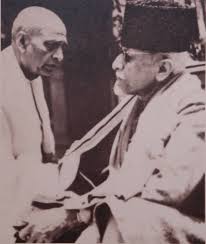 Sarvapalli
Gopal’s account of the controversy vis a vis this elctioncomes up with subtle
innuendoes about the interelationships between Dr Prasad and Nehru on the one
hand and Dr Radhakrishnan and Azad on the other. Yet it remains a fact that
inspite of deep divergences with Dr Prasad. Nehru also had great regard for the
sagacity and nobility of demeanour of the former. Similarly both Dr
Radhakrishnan and Azad were outstanding scholars and great human beings as
individuals in spite of their temperamental angularities. Azad’s soft feelings
for Prasad were essentially due to their long political companionship and the
latter’s incomparable sacrifices during the freedom struggle, besides being
Gandhi’s alter ego.At the CPB meeting Azad had bluntly said to Nehru : “I would
ask you in all earnestness if there is any comparison between Prasad and
Radhakrishnan so far as eligibility for this high post is concerned. Look into
their past, their services to the nation and their respective images as
national leaders.” He even hinted that the brouhaha in the northern press about
the north and south divide over the issue had been carefully raisedonly from a
particular corner. [Handa/68]
Sarvapalli
Gopal’s account of the controversy vis a vis this elctioncomes up with subtle
innuendoes about the interelationships between Dr Prasad and Nehru on the one
hand and Dr Radhakrishnan and Azad on the other. Yet it remains a fact that
inspite of deep divergences with Dr Prasad. Nehru also had great regard for the
sagacity and nobility of demeanour of the former. Similarly both Dr
Radhakrishnan and Azad were outstanding scholars and great human beings as
individuals in spite of their temperamental angularities. Azad’s soft feelings
for Prasad were essentially due to their long political companionship and the
latter’s incomparable sacrifices during the freedom struggle, besides being
Gandhi’s alter ego.At the CPB meeting Azad had bluntly said to Nehru : “I would
ask you in all earnestness if there is any comparison between Prasad and
Radhakrishnan so far as eligibility for this high post is concerned. Look into
their past, their services to the nation and their respective images as
national leaders.” He even hinted that the brouhaha in the northern press about
the north and south divide over the issue had been carefully raisedonly from a
particular corner. [Handa/68]
Gopal’s biased
opinion of Dr Prasad becomes still more apparent when he says that ‘Prasad had
clealrly not given up hopes of a third term even after twelve years in
office’.[304]This seems so unjust, firstly, because Dr Prasad had never
expressed his desire for any covetable position in his life either in the party
or the government. And secondly, he had accepted even a second term, rather
unwillingly, only on popular demand and in the larger interest of Nehru’s own
credibility in the party. Handa tells us that on completion of his first full
term he had already packed his things to exit from Rashtrapati Bhawan at short
notice. In the ultimate analysis,for sure, Dr Prasad, a man of great eminence
and dignity who served the nation three times as President, appears a tragic
figure like Lear – ‘more sinned against than sinning’.
Dr Prasad’s
relations with Dr Radhakrishnan also remained very cordial and mutually
deferential throughout their decade-long close association. It was Nehru who
was responsible for the temporary disaffection between them on the eve of the
second term of the presidency. And though even during that controversy the
others fished in the troubled waters, they themselves never stooped to personal
bickerings. In fact, during their first term in the presidency, they evinced
the best of mutual respect and conviviality. After his return from the USSR as
ambassador, he was elected as the first Vice President in 1952. When he met the
President, Dr Prasad, he said he was now ready to serve ‘at [his] command’ as
‘deputy to the President’; that he was ‘willing to work as [Dr Prasad]
desired’. Dr Prasad told him that ‘it was kind of him to feel that way and it
was a pleasure [for Dr Prasad] to have a counselor of his eminence’. They had a
long pleasant chat over several matters of state policy. Dr Radhakrishnan said
that while serving as ambassador in the Soviet Union he had frankly told Stalin
that unlike their communist ideology promoting violence, India had brought
about a socio-political revolution through non-violence (ahimsa).“We were making a colossal experiment with democracy,” he
said, “and couldn’t desert that either. So we could not adopt communism as long
as it had differences on these basic issues”. [CSD/15.255] With his reverence
for the ancient Indian religious and philosophical values and traditions, Dr
Radhakrishnan, in that sense, was closer to Dr Prasad than to Nehru’s westernized
values and beliefs. In fact, he had the best of the East and the West conjoined
in his fundamental beliefs.With Dr Prasad he fixed up a weekly meeting on
Saturdays to which he stuck routinely. One day when Dr Prasad invited him to
tea he said to him that ‘we ought to keep ourselves in touch with what went on
in the Government’. Since then they met regularly and discussed various issues
of dayto day government policy and, as occasion demanded, shared it with Nehru
and his Cabinet colleagues.
The impression
that we get from Sarvapalli Gopal’s account of the controversy regarding the
election for the second presidency is of a vitiation of a relationships among
the major players in that unfortunate drama, particularly between Dr Prasad and
Dr Radhakrishnan, or between Nehru and Dr Prasad, or Azad and Nehru. Gopal also
throws clear hints of unsavoury relationship between Azad and Dr Radhakrishnan.
But notwithstanding the exigencies of the crucial situation, all of them did
also realize the momentous implications of that historic event. For instance,
Nehru had as high regard for Dr Prasad as Azad himself. He may have misjudged
the political equations prevailing at the time, and may have had his own
perception about Dr Prasad’s continuing on an extra-long innings with his frail
and precarious health. (Dr Prasad was already seventy-three, an advanced age in
those days. And Nehru himself being sixty-seven survived Dr Prasad only by one
year, with both Azad and Pant pre-deceasing them soon after that event.)
They were all
men with great souls and prodigious intellects, men who were not only highly
learned and highly regarded, but men who had an enviable background of making
great contributions in their own fields, be it national service or scholarship.
And when we look at their inter-relationships after that litmus test of their
integrity was over, we find them as amiable and genial as ever, which in
itself is ample proof of their
greatness. Both with Nehru and Dr Radhakrishnan, Dr Prasad remained as convivial
and comfortable throughout as they had been during his last presidency. In a
long diary entry for 8 May, 1952, Dr Prasad had written:‘Dr Radhakrishnan came
to see me’. They first discussed various issues of common interest. And then
they turned to high intellectual discourse in the lighter vein of a ‘casual
chat’.
Then we moved to a casual chat. He
said he was translating the Upanishads.
He had already translated the Gita,
and when he is free from the Upanishads
he would move to another translation. The more he studies the ancient texts, he
remarked, the more is his revernce or the seers of India. What the philosophers of the West have told
us or are telling us today, we find it already enshrined in the Upanishads. Our ancient sages have
expressed them in almost identical words. As an example, Dr Radhakrishnan
referred to Spinoza and Hegel whose phiolosophical postulates may be found
expressed in similar terms in Chhandogyopanishad.
The findings of the great physicist Dr Einstein are in tune with the views of
our philosophers which we can feel and experience in our physical world.
Consder, for instance, the terms ‘sansar’ and ‘jagat’ (both standing for
world), etymologically derived from a root which means ‘to move’. The Western
philosophers too emphasise the relationship between ‘motion; and ‘matter’. We
don’t see these correspondences between Indian and Western systems and
therefore have scant respect for our heritage. If we value our heritage we
shall have found solutions to all our problems there….While leaving he
presented me a copy of an anthology of some select texts from his writings
compiled by a British editor. .[CSD/15.283]
With Nehru, of
course, Dr Prasad would not engage in
such high philosophical discourses, and would generally discuss more
mundane matters of government policies and actions. But with Dr Radhakrishnan
their level of discussions was, by and large, on a higher plane of
spiritualism. And this spirit of conviviality and mutual respect between the
two great men continued in spite of the second
prsidential election controversy, till the very end ofDr Prasad’s last
term as President.
When Dr Prasad’s
second term of presidency was drawing to a close, he seemed to have grown
rather more sullen and frustrated about the way things were being run both in
the government and the party. “He had long ceased bothering the Prime
Minister”, writes Handa, “with his suggestions and advice. About the future of
the country he could not help thinking, but most of the thoughts he preferred
to keep to himself. With sorrow he recollected the advice he had tendered on
various occasions to the Prime Minister.” [164] No doubt, all along the
presidential decade, the official relationship between the President and the
Prime Minister had seldom been on an even keel. But his relationship with Dr
Radhakrishnan even till the very end had remained as pleasant and genial as
ever. As Handa recalls in his memoirs,
 Radhakrishnan and Rajendra Prasad
had never been so close to each other as now; they had always been good
friends, though.Whatever misunderstanding there might have cropped up
immediately before the 1957 Presidential election was now cleared. The
intiative in making a clean breast of everything, it must be said, was taken by
Radhakrishnan himself. He pooh-poohed the idea of anyone suggesting a change in
1957 on the plea of placating the South. “To think of it, Rajen Babu, is as
unfair to you as to the South”, he said. Referring to Nehru in that context,
Radhakrishnan pleaded that with all his experience of men and matters, the
Prime Minister was too much of an innocent who lent his ears to others too
readily. Both of them laughed and looked into each other’s eyes. [165]
Radhakrishnan and Rajendra Prasad
had never been so close to each other as now; they had always been good
friends, though.Whatever misunderstanding there might have cropped up
immediately before the 1957 Presidential election was now cleared. The
intiative in making a clean breast of everything, it must be said, was taken by
Radhakrishnan himself. He pooh-poohed the idea of anyone suggesting a change in
1957 on the plea of placating the South. “To think of it, Rajen Babu, is as
unfair to you as to the South”, he said. Referring to Nehru in that context,
Radhakrishnan pleaded that with all his experience of men and matters, the
Prime Minister was too much of an innocent who lent his ears to others too
readily. Both of them laughed and looked into each other’s eyes. [165]
Sarvapalli Gopal’s
innuendoes in his biography of Dr Radhakrishnan about Dr Prasad’s keenness for
his presidential tenures, or his alleged lure for them, therefore, seem rather
indecorous and unfair. For instance, it seems patently scurrilous when,
commenting on Dr Prasad’s unconvincing‘desire to retire from office’, he
brashly observes: “But it was thought that, even if he had to go, he would have
preferred someone other than Radhakrishnan to succeed him.” [305]Indeed, it is
difficult to see how Radhakrishnan himself would have reacted to such an
improper and unsubstantiated insinuation! True, great men, too, have their
frailties, their moments of vulnerability, and quite often they commit
historical errors – sometimes even ‘Himalyan blunders’ –but history always
venerates them for their great deeds. And inperpetuating their memories in reminiscences and solemnizing
their lives in biographies we must be as objective and unbiased as possible,
both in respect of theirpetty flaws and their sterling virtues.
(C) Dr BSM Murty
No part of the extract an be used in any way so as to infringe pre-publication rights.
(C) Dr BSM Murty
No part of the extract an be used in any way so as to infringe pre-publication rights.
More extracts can be read on this Blog from the
book GEM OF A NATON
Please click on the Archive year and scroll down to
the extract.
2011: May 28 : The
Indigo Story; July 8: The Butcher of Amritsar; July 17: A Planter’s Murder
2014: Sep 14 : The
Seven Martyrs; Dec 3 : Early childhood in Jeeradei
2015: Jun 30: Congress
in disarray; Aug 27: Clash of Convictions; Oct 8: Presidential
Itineraries;
Dec
20: Congress at crossroads


